


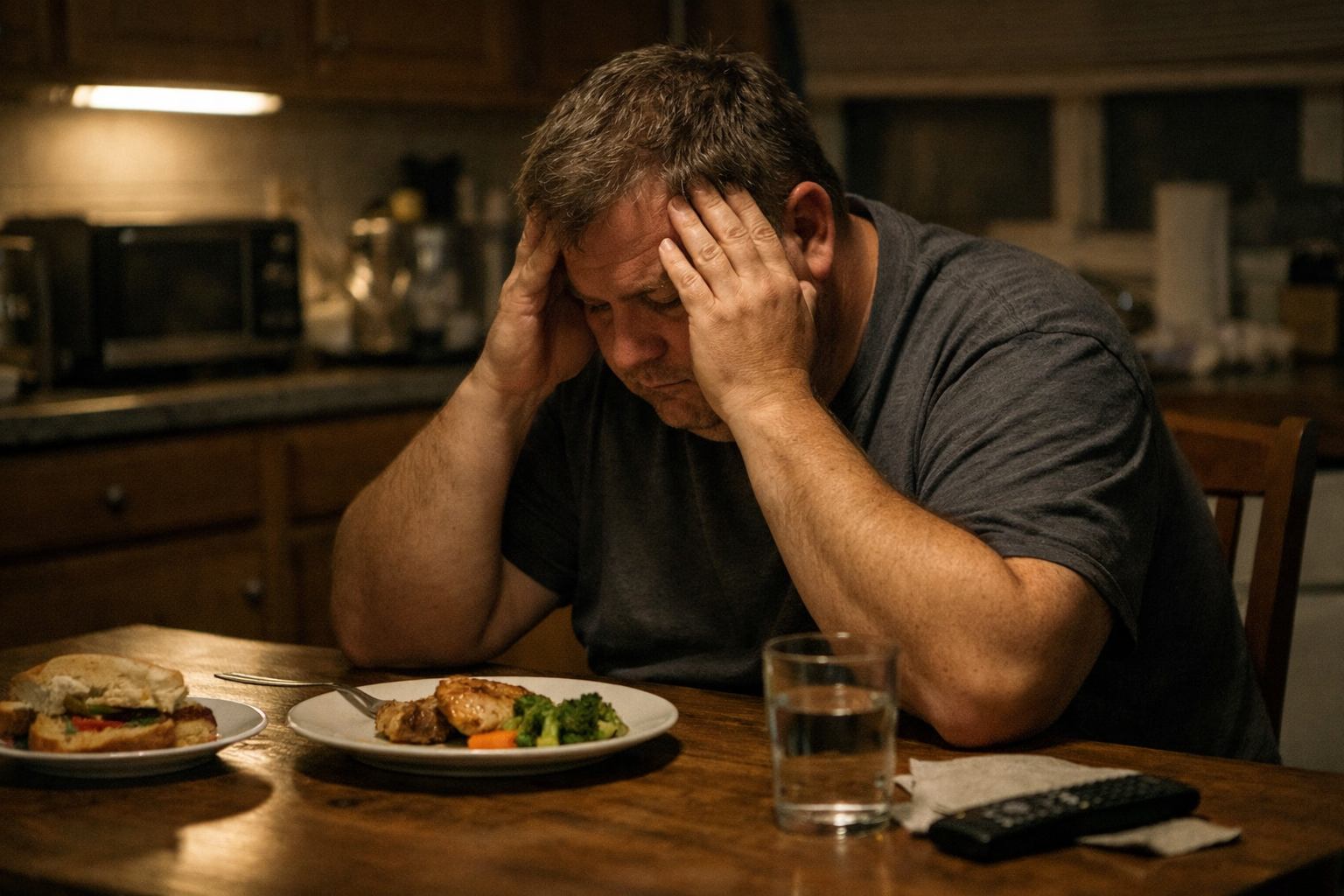

Let’s get something straight immediately. Your weight is not confusing. It is not stubborn. It is not resistant. It is not waiting for the right plan, the right insight, or the right motivation. Your weight is doing exactly what it is supposed to do in response to the choices you make over and over again.
That sentence pisses people off because it removes the most comforting lie in the weight-loss industry: the idea that something external is standing between you and results. Genetics. Hormones. Age. Stress. A broken metabolism. A plan that didn’t quite fit your life. All of those explanations feel good because they shift responsibility away from the only place it actually lives.
Your weight is not a mystery. It is an outcome.
If you are still asking why you can’t lose weight, it is not because you lack information or effort. It is because you are misidentifying the cause. You are looking for solutions in food rules, programs, and tactics while ignoring the decision patterns that produce your reality.
Weight loss is not governed by what you know. It is governed by what you choose when comfort and consequence are in conflict.
This article exists to explain that mechanism clearly and without apology. Not to motivate you. Not to inspire you. Not to sell you discipline or hope. To explain, precisely, why your choices decide your weight and why nothing changes until that truth is confronted head-on.
The weight-loss world is obsessed with plans. Plans feel productive. Plans feel responsible. Plans give people something to follow so they don’t have to look too closely at how they actually live. When a plan fails, it becomes the villain, and the person gets to walk away intact.
The problem is that plans do not live your life. You do.
No plan chooses what you eat when you are exhausted. No plan decides what happens on weekends. No plan overrides stress, boredom, travel, alcohol, social pressure, or fatigue. Those moments are governed by choice, not structure.
This is why people lose weight on a plan and gain it back when life shows up. The plan worked. Their choices never changed.
People love to say they already know what to do. In most cases, they are right. They know what foods support fat loss. They know movement matters. They know sleep matters. They know alcohol matters. They know consistency matters.
And yet nothing changes.
Knowing what to do does not make you do it. Knowing what to do does not mean you want to do it. Knowing what to do does not mean you will choose it when it competes with relief.
This is where smart people get stuck. They assume awareness should be sufficient. When it isn’t, they start blaming willpower, discipline, or themselves instead of recognizing the real issue. Awareness does not execute behavior. Choice does.
This is also why dieting continues to fail as a long-term strategy. Dieting focuses on compliance rather than decision-making. It works only as long as the rules feel stronger than the desire to break them. Once that balance shifts, the diet collapses.
This pattern is not theoretical. It is structural. It is why diets fail even when people are sincere, motivated, and intelligent.
Most weight gain has nothing to do with hunger. Hunger is convenient because it sounds biological and unavoidable. The real driver is comfort.
Comfort eating. Comfort drinking. Comfort resting. Comfort avoiding. Comfort numbing.
Comfort feels earned. Comfort feels justified. Comfort feels harmless. Comfort is the decision that keeps people fat.
No one gains weight because of one bad day. They gain weight because comfort consistently wins the internal negotiation. One snack does not matter. One drink does not matter. One skipped workout does not matter. Thousands of those choices matter.
Weight responds to patterns, not promises.
This is why people genuinely believe they are trying while their weight keeps climbing. They are trying inside the same behavioral framework that produced the problem. Effort increases. Direction does not change.
Willpower is the excuse people lean on when they do not want to redesign their life. Willpower sounds noble. It sounds personal. It sounds like strength.
It is a trap.
Willpower requires you to fight yourself constantly. That fight is exhausting, unreliable, and unsustainable. Anyone can white-knuckle a few weeks. Almost no one can white-knuckle a lifetime.
People who maintain weight loss do not rely on willpower. They remove negotiation. They reduce exposure. They simplify decisions. They build defaults that support outcomes instead of sabotaging them.
If your strategy depends on being “on” all the time, it will fail. Not because you are weak, but because the strategy is stupid.
Your environment is not neutral. It is voting on your weight every single day.
What is easy. What is visible. What is available. What is socially reinforced. Those factors matter more than intention ever will. You do not rise to your goals. You fall to your defaults.
People say they want to lose weight while living in environments designed to keep them exactly where they are. Kitchens built for grazing. Social lives built around alcohol. Weekends built around indulgence. Stress managed through food and avoidance.
Then they wonder why nothing changes.
Changing outcomes requires changing the conditions under which choices are made. That is not restriction. That is responsibility.
Weight is not decided by dramatic moments. It is decided by boring ones. Breakfast choices. Evening routines. Weekend structure. Travel behavior. How stress is handled when no one is keeping score.
Those moments feel too small to matter. That is why they matter most.
This is also why shortcuts fail. Detoxes fail. Resets fail. Intensity fails. They do not alter the underlying choice pattern. When the shortcut ends, behavior reverts and the weight follows.
Tracking tools and accountability systems expose behavior. They do not change it. Without choice alignment, tracking becomes another way to collect data about why you are still stuck.
This is why people can log every meal and still gain weight. Measurement without ownership produces awareness, not results.
Stress and fatigue are not excuses. They are predictable triggers. Under cognitive load, decision quality drops. People default to what is familiar and comforting. If your system only works when life is calm, it is not a system. It is a fantasy.
Identity reinforces all of this. People behave in alignment with how they see themselves. If your identity never changes, your choices will not either. Temporary behavior layered onto a permanent self-image always snaps back.
This is why people say they “fell off.” They did not fall. They returned to who they were choosing to be.
When someone says they have tried everything, what they really mean is they have tried many things without changing the decisions that define their days. Trying preserves an escape hatch. Choosing closes it.
Different packaging does not produce different outcomes. Different choices do.
Responsibility scares people because they confuse it with blame. Responsibility is not blame. Responsibility is power. Blame keeps you stuck. Responsibility gives you leverage.
When weight is framed as something that happens to you, you are powerless. When it is framed as something you choose repeatedly, you regain control. This is the core of the Stop Dieting. Start Choosing. philosophy.
Sustainable change does not begin with a plan. It begins with honesty. With admitting that your current results are not accidental. They are earned through repetition.
Long-term change requires structure, consistency, and a refusal to negotiate with yourself. It requires choosing alignment over relief, even when no one is watching and no one is applauding.
I did not lose 140 pounds by finding a magic method. I lost it by changing what I chose to do every day and refusing to pretend that comfort was harmless.
Most people are not failing because they lack motivation, discipline, or intelligence. They are failing because the problem has been misdiagnosed. Weight is not a motivation problem. It is a choice problem.
Your weight is not stubborn. It is obedient. It responds perfectly to what you choose repeatedly.
If outcomes are not changing, choices are not changing. That is not judgment. It is reality.